
Helping bigger baskets
reach checkout.
Exploring how recommendations, sellers and delivery work together to help customers complete a multi-item purchase.
A growth question,
a customer experience problem.
My focus was problem framing, behavioral analysis, seller and fulfillment mapping, concept exploration and experiment planning. The work shown here is discovery and proposed design direction.
Help useful baskets survive checkout.
Business: improve Item Per Order and completed multi-item purchases. Customer: find relevant additions, understand seller and delivery trade-offs, and stay in control of total cost and choices.
Discover → Define → Develop → Validate
Behavioral baseline → insights and hypotheses → journey and system mapping → concept prioritization → interface exploration → usability and experiment plan → handoff and learning.
A small basket.
A bigger question.
The initial business question was how to increase Item Per Order (IPO). The behavioral signal shifted the focus toward what happens before checkout.
of completed orders
contained one item.
Single-item orders were even more common in Express and FBM.
Some single-item buyers
already had a bigger basket.
About 20% of users who completed a single-item order had more than one item in their cart five minutes earlier.
What makes customers
remove the second item?
The data showed removal, not its cause. Shipping cost, seller fragmentation, budget and changing intent remained hypotheses to investigate.
Separate the signal
from its explanation.
The available evidence describes basket behavior and fulfillment structure. It does not establish the motivation behind an item removal.
Behavior + system analysis
Review the single-item order baseline and the five-minute basket signal. Map seller × available delivery method × selected method. Examine the initial FBM consolidation opportunity.
What changed before purchase?
Shipping fees, separate deliveries, budget, trust, recommendation relevance and changing needs are hypotheses. Removal prompts and customer interviews are proposed next steps; no interview findings are claimed.
Help customers keep relevant items in their basket while making the full seller, delivery and cost picture clear?
Design for completed purchases and explicit choices, with checkout conversion as a guardrail.
Show the consequence
before asking for an addition.
This illustrative flow translates the basket signal into moments to explore. It is a design hypothesis, rather than an observed interview journey.
Product page
See a relevant complementary item at high purchase intent.
Compare options
Understand seller, method, availability and total cost.
Add deliberately
Keep the selected seller and delivery; confirm any change.
Review basket
See separate shipments and fees before checkout.
Two products.
More than one journey.
Adding another product can also add another seller, delivery fee, arrival time and shipment. I mapped these dependencies before proposing the interface.
Main purchase
Seller A · ExpressComplementary item
Seller B · ExpressSame delivery label.
Potentially separate shipments.
Consolidation depends on seller and operational compatibility. An Express label alone does not guarantee one shipment.
of FBM shipments had
consolidation potential.
The initial analysis identified an opportunity to examine fulfillment itself, alongside changes to discovery and recommendations.
Potential · not realized savingsSeller × available method × selected method
A simplified summary of the scenarios explored.
| Seller relationship | Delivery compatibility | Design implication |
|---|---|---|
| Same seller | Compatible | Check consolidation eligibility |
| Same seller | Different methods | Explain the trade-off before switching |
| Different sellers | Both Express | Do not promise a single shipment |
| Any seller | Selected method unavailable | Offer an alternative; preserve user choice |
Relevant to the product.
Compatible with the basket.
I explored two recommendation directions: adding a useful complementary item at a moment of high purchase intent, and making that addition easier to fulfill.
Product relevance
Does this item help?
Seller compatibility
Who fulfills it?
Delivery compatibility
Can it fit this order?
Purchase intent
Is this the right moment?
Recommendations with
more context.
Prioritize relevant items from the current seller, then check whether they are eligible for the selected delivery method.
Reconstructed explanation of the proposal. This is not a shipped screen or a validated recommendation algorithm.
Your basket
More from this seller
Delivery eligibility is checked before promising consolidation.
Useful additions.
Fewer avoidable costs.
Compared with bundles, discounts, seller-page improvements and operational changes, these were chosen as initial directions to test against impact, effort, dependencies and speed of validation.
Make the trade-offs visible.
- Same seller, incompatible delivery method
- A different seller offers a simpler combination
- An item becomes unavailable for the chosen method
- A method switch could allow consolidation
No automatic seller or delivery switch without a clear customer choice.
A temporary visual,
a specific design intention.
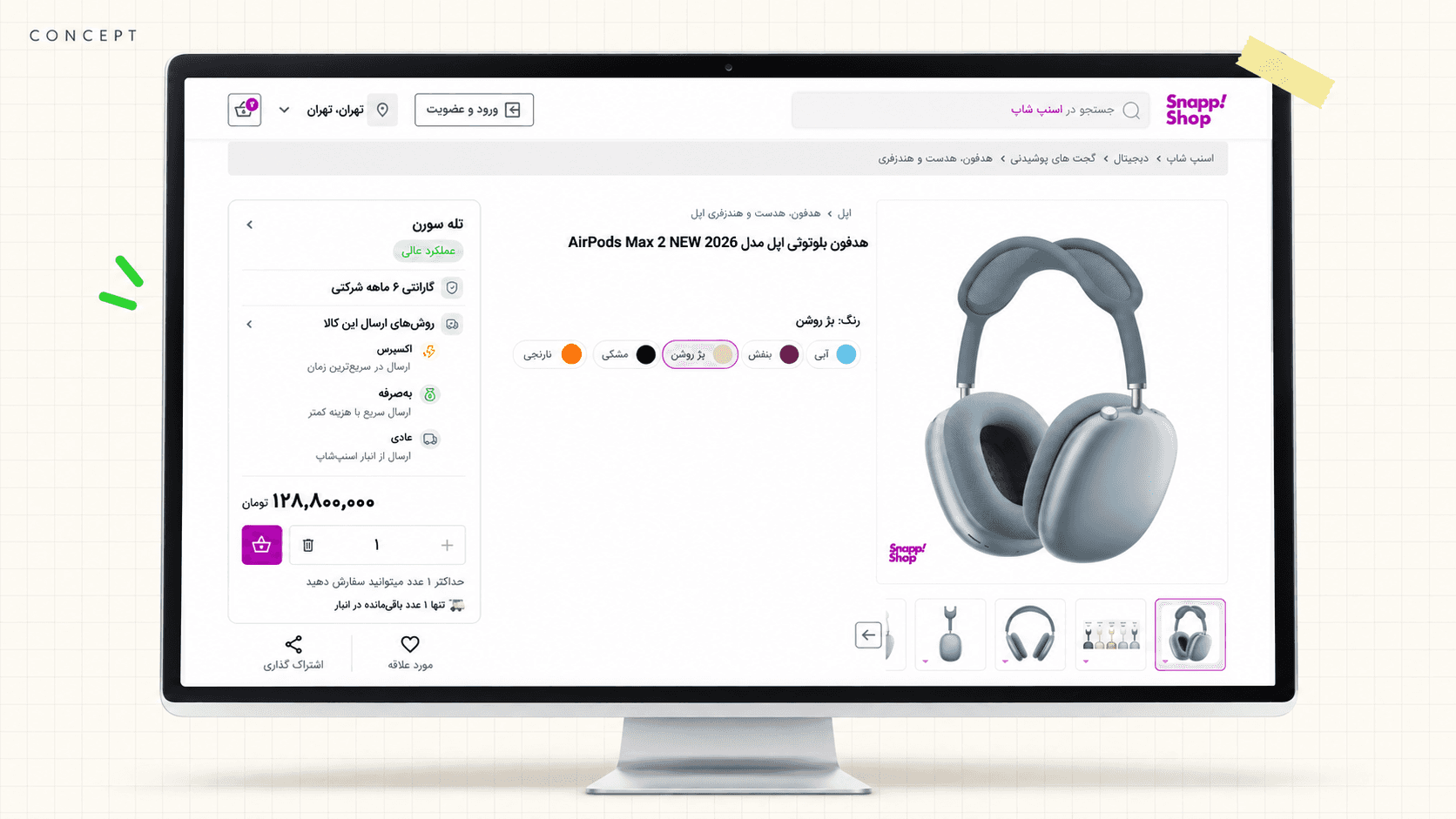
The mockup uses the supplied Snapp!Shop product-page screenshot. Concept images will be replaced with final project screens when available.
Keep context beside the recommendation.
Wireframe intent: product context → relevant addition → seller and delivery details → explicit add action. The interactive schematic above compares the two directions.
Test understanding before persuasion.
Find a compatible accessory, explain whether it adds a shipment, compare an alternate seller, and recover from an unavailable method. Observe comprehension, task completion and unintended switches.
Evidence first.
Then the experiment.
The 20% signal explains what happened. These proposed research steps would help establish why, before judging either recommendation direction.
Trace the removal
Analyze add → remove → purchase events alongside seller, fees, delivery time and checkout progression.
Ask what changed
Use a lightweight removal-reason prompt and interviews to test shipping, budget, relevance and intent hypotheses.
Test incrementally
Compare the directions in controlled experiments, looking for completed multi-item orders without harming checkout.
More complete purchases
Item Per Order · Multi-item order share
Basket size · Average Order Value
Keep checkout healthy
Checkout conversion · Cart abandonment
Removal rate · Shipping-cost impact · Recommendation CTR
Make the hypothesis
testable in production.
Proposed handoff combines recommendation rules, fulfillment eligibility, interface states and measurement. Operational compatibility needs confirmation before showing consolidation claims.
Design specification
Document default, loading, empty, unavailable and error states, price changes, seller changes and delivery-method choices.
Engineering alignment
Confirm seller and fulfillment eligibility, stock freshness, total-cost calculation and explicit consent for changes.
Measurement plan
Instrument impression → click → add → remove → checkout → purchase. Compare controlled variants and review conversion, cost and abandonment guardrails.
Users were already
building bigger baskets.
The opportunity was to understand what made those baskets harder to complete. Growth in a marketplace connects discovery, seller architecture, pricing, delivery and checkout.